Executive summary
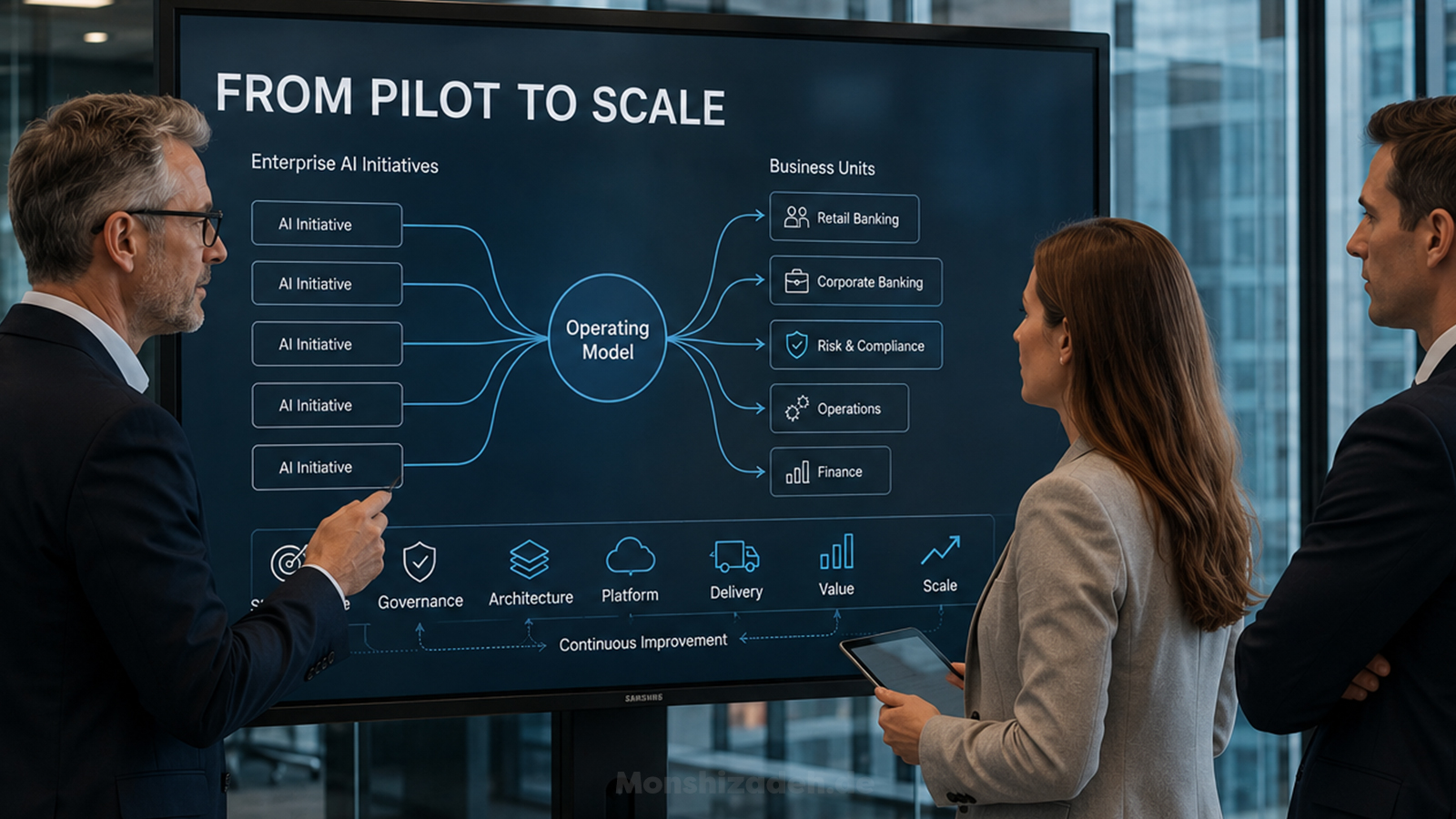
There is no shortage of successful AI pilots. Almost every large organisation has one. Some have dozens; others have hundreds. They demonstrate impressive accuracy, employees like them, executives applaud them, and the board hears encouraging progress updates. And then nothing happens. The pilot quietly disappears, the team moves on, the budget expires, and another pilot begins.
Months later, the organisation proudly reports that it has completed fifty AI initiatives — yet almost none of them have fundamentally changed how the company operates. If this sounds familiar, you are not alone. It is one of the most common patterns I encounter when discussing AI transformation with executives across financial services and large enterprises.
Ironically, the problem is rarely the pilot itself. Most pilots actually work. What fails is the transition from isolated success to enterprise capability. A pilot proves technology; scaling proves organisational maturity. The organisations leading the AI race understand this distinction. Many others still do not.
The most expensive success story
One conversation has stayed with me. A senior executive proudly explained that their organisation had completed more than forty AI proof-of-concepts within eighteen months. The presentations looked impressive, the demonstrations were convincing, and the technical teams had done outstanding work. I asked a simple question: “How many of those solutions are now part of your daily business operations?” The room became unusually quiet. Eventually someone answered: “Three.”
That answer tells us almost everything we need to know. The organisation did not have an innovation problem. It had a scaling problem. And those are two very different things.
The AI pilot illusion
Pilots create momentum. They generate excitement. They show what is technically possible. That is exactly what they are supposed to do. But somewhere along the way many organisations begin believing that a successful pilot automatically leads to enterprise adoption. It doesn't.
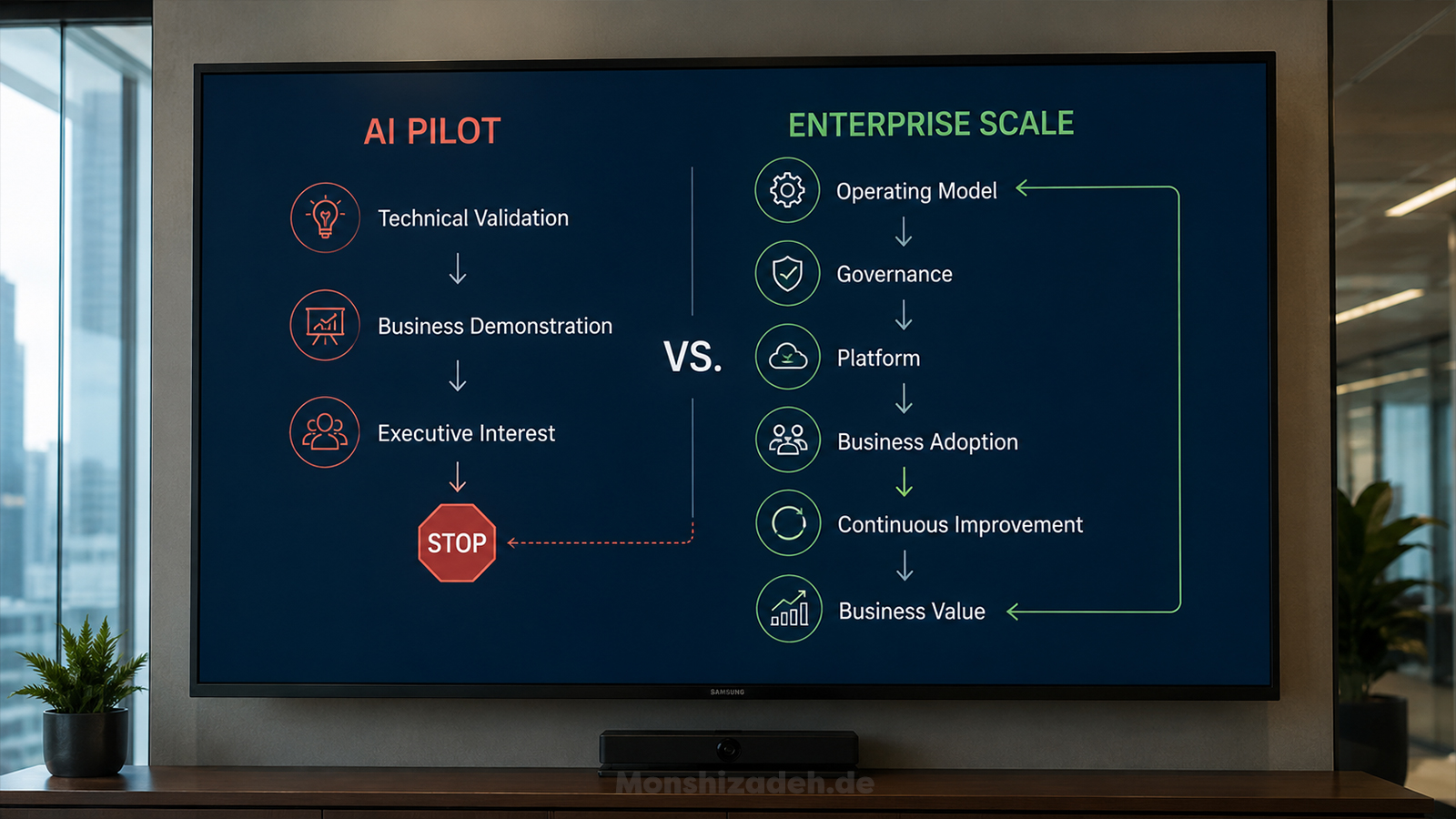
A pilot answers questions such as: can the technology work, can we access the data, can we build the model, can users interact with it? Enterprise scale asks completely different questions: can hundreds of teams use it, can Risk approve it, can Security support it, can Compliance govern it, can Operations maintain it, and can the organisation afford to operate it for years? Those questions rarely appear during a proof of concept, yet they ultimately determine whether AI creates lasting value.
Why pilots feel successful
There is another reason pilots create a false sense of progress. During a pilot almost every condition is ideal. The project receives executive attention, the most experienced engineers participate, the scope is deliberately narrow, business users are highly engaged, problems are solved immediately, funding is available and decision-making is fast.
Reality looks very different once the solution leaves the pilot environment. Now it must compete with every other initiative. Budgets become constrained, priorities shift, different departments request changes, Risk asks additional questions, Legal becomes involved, architecture standards suddenly matter, security reviews begin, infrastructure teams need to support production, support teams require documentation, training becomes necessary and monitoring must be established. Suddenly the AI solution is no longer a demonstration. It has become an enterprise product — and that transition is where most organisations struggle.
The real difference between innovation and transformation
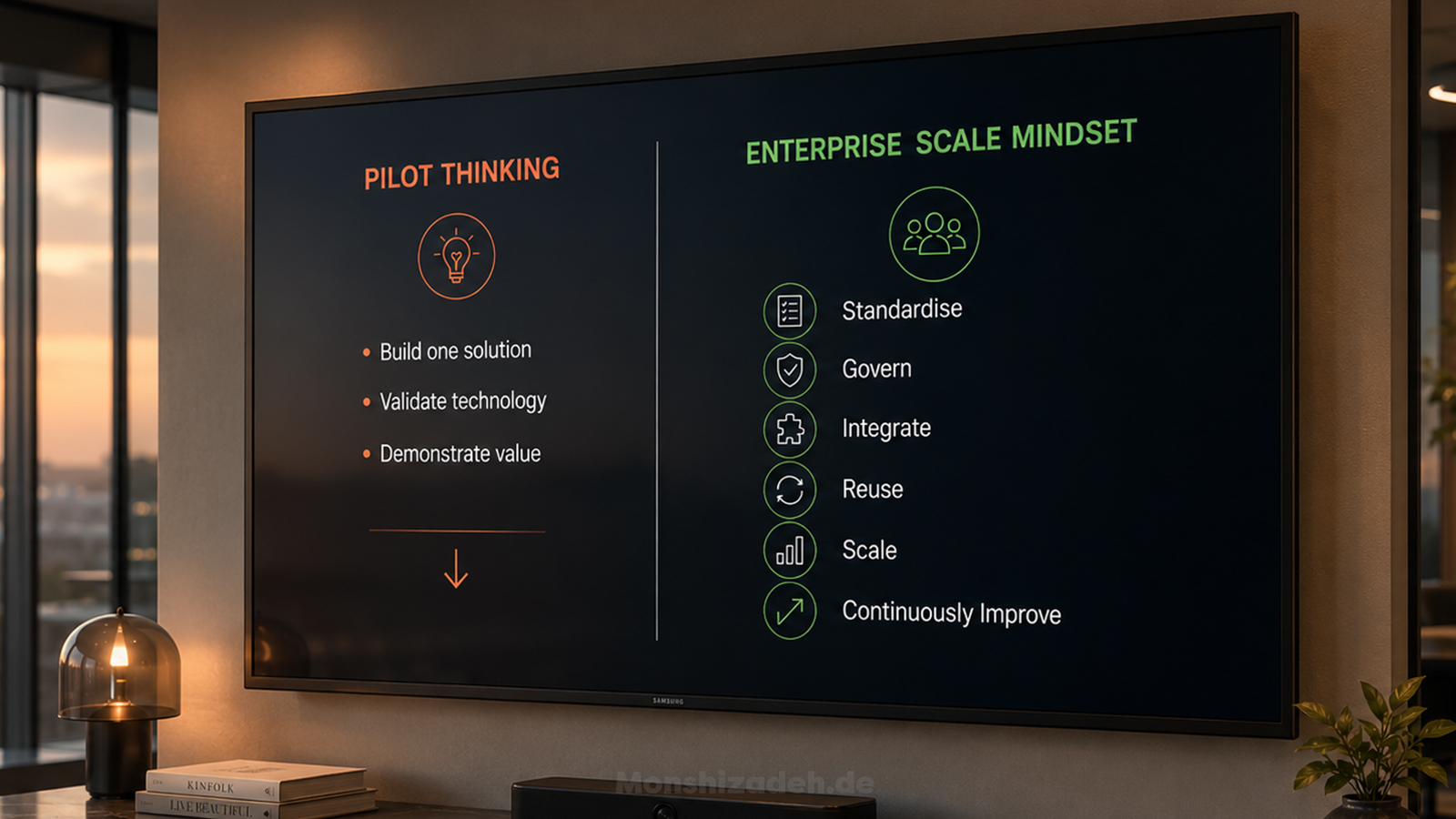
Innovation is about discovering new possibilities. Transformation is about changing how an organisation works. Those are fundamentally different disciplines. Innovation celebrates experimentation; transformation demands consistency. Innovation rewards speed; transformation requires governance. Innovation tolerates failure; transformation depends on repeatability.
Many companies become exceptionally good at innovation. Far fewer become equally good at transformation. That is why organisations proudly showcase dozens of pilots while continuing to operate exactly as they did before. The AI changed. The organisation didn't.
| Innovation | Transformation |
|---|---|
| Discovers new possibilities | Changes how the organisation works |
| Celebrates experimentation | Demands consistency |
| Rewards speed | Requires governance |
| Tolerates failure | Depends on repeatability |
| Proves what is technically possible | Proves organisational maturity |
| Produces impressive pilots | Produces enterprise capabilities |
Why technology isn't the bottleneck
Whenever AI programmes stall, technology often receives the blame: the models are not mature enough, the infrastructure needs improvement, the data quality is insufficient. Those issues certainly exist, but in my experience they are rarely the primary obstacle. The larger challenge usually sits elsewhere — decision-making, ownership, funding, governance, business alignment and organisational readiness. Technology evolves remarkably quickly; organisations evolve much more slowly. That is why scaling AI has far more to do with leadership than with algorithms.
Enterprise scale begins with a different question
Instead of asking “can we build this AI solution?”, successful organisations ask “how will this capability become part of the way we operate?” That single question changes the entire conversation. Instead of discussing models, people begin discussing ownership. Instead of selecting vendors, they define governance. Instead of celebrating pilots, they measure adoption. Instead of counting projects, they evaluate business outcomes. That shift represents the true beginning of enterprise AI.
Why organisations get stuck after the pilot
If you analyse enough AI programmes — different industries, different technologies, different leadership teams — remarkably similar outcomes emerge. The technology works, the pilot succeeds, the business is interested, and then progress slows down. Not because people stop believing in AI, but because the organisation reaches a point where technical excellence is no longer enough. Scaling now depends on organisational capability. Below are the seven obstacles I encounter most frequently.
1. AI has no clear business owner
One of the most common mistakes is assuming AI belongs to IT. It doesn't. Technology enables AI; the business creates value. Without a business owner accountable for measurable outcomes, AI remains a technical initiative rather than an operational capability. The question should never be “who built the model?” but “who owns the business process this model improves?” Without ownership, nobody feels responsible for long-term success.
2. Every department builds its own AI
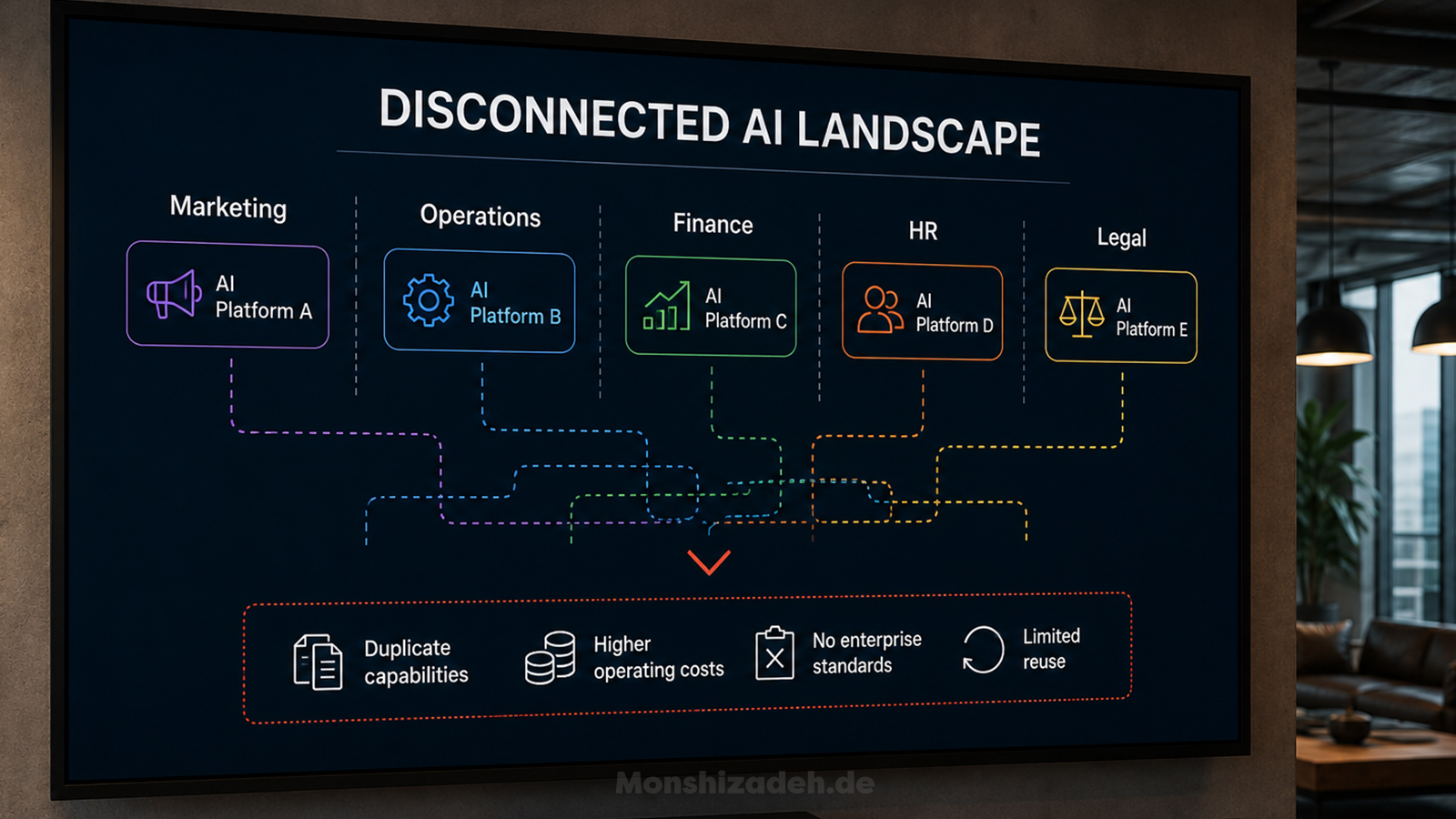
This pattern appears surprisingly early. Marketing purchases one platform, HR introduces another, Operations builds internal solutions, Legal experiments independently, Finance signs contracts with different vendors. Each department makes reasonable decisions; collectively, the organisation creates fragmentation — different models, contracts, governance, security controls, prompt libraries and architectures. Within two years, executives wonder why AI has become so expensive. The answer is duplication, not innovation.
3. Governance arrives too late
Many organisations proudly describe themselves as “agile.” Unfortunately, some interpret agility as postponing governance. The project begins, the model is developed, the demonstration succeeds — and only then are Risk, Compliance, Cyber Security and Legal invited. Predictably, concerns emerge: documentation is incomplete, controls are missing, data usage is unclear, security reviews require redesign, deployment is delayed. Governance didn't create the delay; the absence of early governance did. Good governance accelerates delivery because it removes uncertainty before uncertainty becomes expensive.
4. Nobody designed for scale
Pilots optimise for success; enterprise products optimise for sustainability. That distinction changes everything. Questions that rarely matter during a proof of concept suddenly become critical: can thousands of employees use the solution, can infrastructure scale, can models be monitored continuously, who updates prompts, who retrains models, who manages suppliers, who maintains documentation, who handles incidents? Scaling is not a technical upgrade. It is an operational design exercise.
5. Success is measured incorrectly
Many executive dashboards focus on activity rather than outcomes — number of pilots, models, workshops, ideas, users. These metrics look encouraging but don't necessarily indicate value. Better executive questions: how much manual work has been eliminated, how much faster are critical decisions, how much operational risk has been reduced, which customer journeys have improved, how much additional revenue has AI generated? Business value — not technical activity — defines successful AI transformation.
6. Nobody owns the platform
As AI grows, organisations discover that isolated solutions become increasingly difficult to maintain. Shared infrastructure becomes essential: foundation models, model registries, prompt libraries, security controls, monitoring, identity management. Without a common platform, every project rebuilds the same capabilities, and costs, complexity and operational risk all increase. The platform becomes just as important as the models running on it.
7. AI remains an innovation programme
This may be the most significant challenge of all. Many organisations continue treating AI as a temporary innovation initiative: innovation teams demonstrate possibilities, business teams applaud, leadership celebrates, then everyone moves on. Enterprise AI cannot remain permanently inside an innovation lab. Eventually it must become part of everyday business operations — and that transition, from innovation to operational capability, is where genuine transformation begins.
What enterprise scale actually looks like
When organisations successfully scale AI, the conversation changes. People stop asking “which model should we use?” Instead they ask: how should this capability integrate into existing business processes, which governance standards already exist, can another department reuse this solution, which enterprise platform components are available, how do we measure value after deployment? Those questions indicate organisational maturity. Technology becomes an enabler rather than the centre of attention.
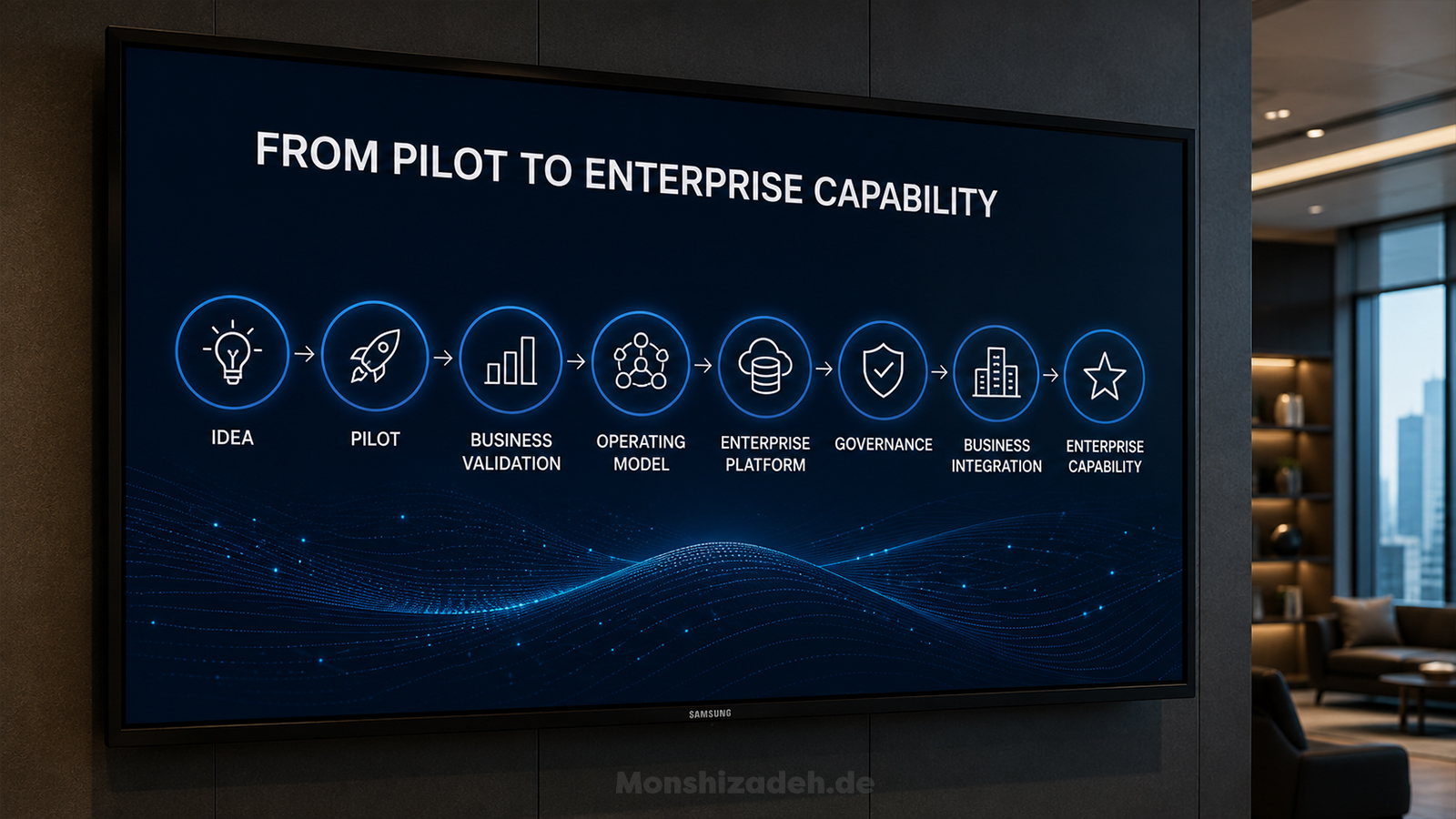
Building an organisation that can scale AI
At this point one conclusion should be obvious. Successful AI transformation has very little to do with building better models. It has everything to do with building a better organisation. Technology enables change; organisations determine whether that change survives. The companies leading enterprise AI today rarely possess dramatically better algorithms than everyone else. What they possess is something far more valuable: consistency. Every initiative follows similar governance, every business unit works within the same architecture, every project benefits from lessons learned elsewhere. Knowledge accumulates, capabilities improve, delivery becomes predictable. That is what enterprise maturity looks like.
The enterprise AI maturity journey
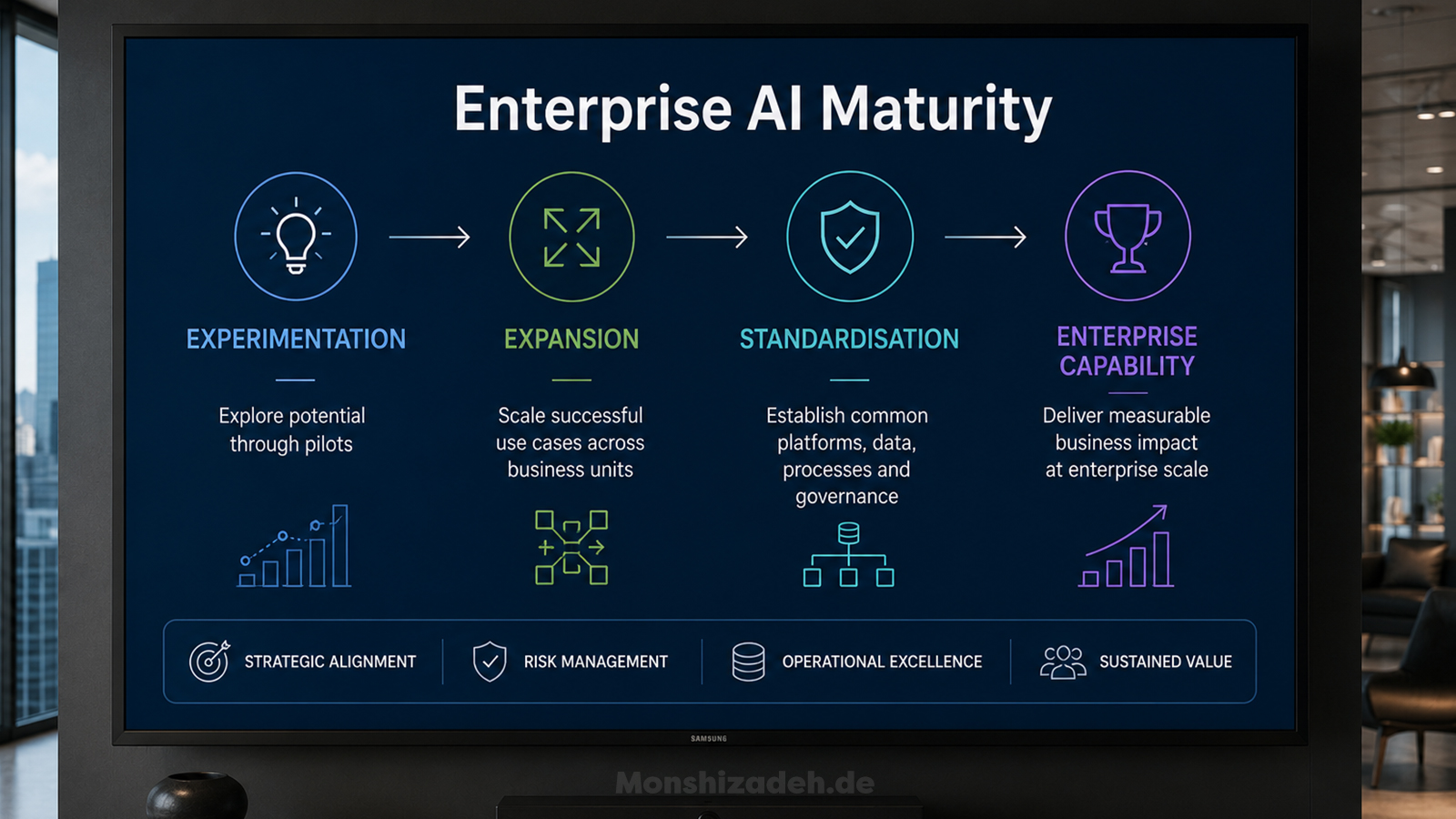
Most organisations evolve through four distinct stages. Understanding them helps leaders identify where they are today — and what comes next.
Stage 1 — Experimentation
Everyone is curious. Small pilots emerge across the organisation, business units experiment independently, and success is measured by enthusiasm rather than outcomes. At this stage fragmentation is perfectly normal; the objective is learning.
Stage 2 — Expansion
More departments become interested, budgets increase, executives ask for roadmaps and the number of initiatives grows rapidly. Unfortunately, so does duplication — different vendors, governance, architectures and security controls. This is the stage where many organisations mistakenly believe they are scaling. They are not. They are multiplying complexity.
Stage 3 — Standardisation
Leadership recognises the growing complexity and begins defining common standards. Shared platforms emerge, governance becomes consistent, architectural principles become mandatory and reusable services appear. This is usually the point where AI begins creating enterprise value rather than isolated project success.
Stage 4 — Enterprise capability
Eventually AI becomes invisible. That might sound strange, but it is the ultimate objective. Nobody says “we're using cloud” or “we're using databases” — they simply perform their work. The same will happen with AI: employees stop talking about it and simply work differently. That is when AI has become an enterprise capability.
What boards should really ask
Board meetings often include impressive AI presentations — new copilots, new models, new partnerships. Those discussions are valuable, but not enough. Boards should ask different questions: do we have one enterprise AI strategy, who ultimately owns AI, how many AI platforms are currently operating, can successful solutions be reused, how much measurable business value has AI created, which initiatives should be stopped? Those questions reveal organisational maturity far more effectively than another product demonstration.
A practical framework for every executive
Whenever I discuss enterprise AI with leadership teams, I suggest evaluating every initiative using five simple questions.
- Strategic alignment — does this initiative directly support one or more strategic business objectives?
- Business ownership — who owns the outcome after deployment?
- Enterprise reuse — can another department benefit from the same capability?
- Operational readiness — can Operations, Security, Risk and Compliance support this solution over the long term?
- Business value — how will success be measured six months after deployment?
If any of these questions cannot be answered confidently, the organisation is probably not ready to scale.
Final thoughts
Over the next decade, every large organisation will invest in artificial intelligence. Some will purchase better models, some will hire exceptional engineers, some will implement impressive technology. Only a few will fundamentally change the way their organisation operates. Those organisations will not win because they adopted AI first. They will win because they built an organisation capable of absorbing AI continuously, responsibly and at scale.
Technology will keep changing. Models will improve. Platforms will evolve. But one thing will remain remarkably constant: the organisations with the strongest operating models will continue to outperform those still chasing the next exciting pilot. That is why I believe the future of enterprise AI will not be defined by algorithms. It will be defined by leadership, by governance, by organisational design, and by the willingness to move beyond experimentation toward genuine transformation.
Executive checklist
Before approving your next AI initiative, ask yourself:
- Is there a clearly defined business problem?
- Is there an accountable business owner?
- Can the solution reuse enterprise capabilities?
- Are governance and Risk involved from the beginning?
- Is the platform scalable?
- Can another department adopt the solution?
- Have success metrics been defined before development begins?
- Will this initiative still deliver value two years from now?
If several answers are “no,” don't build another pilot. Build the organisation that allows successful pilots to scale.