

Executive summary
Technical debt has traditionally been treated as an engineering concern — a problem for developers, a topic for architects, an item that eventually surfaces in an IT investment proposal. In regulated industries that view is now dangerously outdated. Technical debt has become a governance issue, a resilience issue, a compliance issue and, increasingly, a board-level responsibility.
Every year an organisation postpones modernisation, legacy complexity grows. Processes become harder to control, operational risk rises, audit findings become harder to resolve, and regulatory change takes longer to implement. This rarely happens because leadership consciously decides to accept the debt. It accumulates quietly: one postponed upgrade, one temporary workaround, one unsupported integration, one application that “still works.” Each decision looks rational in isolation; together they reshape the organisation into something fragile.
The organisations that outperform understand something different. Technology modernisation is not an IT programme. It is an investment in organisational resilience — one of the most valuable strategic assets any regulated institution can build.
The most dangerous risk is the one you cannot see
When boards discuss risk, the conversation gravitates to visible threats: cyber attacks, regulatory investigations, market volatility, operational incidents. Those deserve attention. They are immediate, measurable and demand action. Technical debt behaves differently. It grows silently. Nothing appears broken, critical systems keep running, customers rarely notice and revenue keeps flowing. From the outside, everything looks stable.
Inside, complexity compounds. Every new application requires more interfaces. Every regulatory change demands more manual work. Every architecture decision becomes more constrained by choices made years earlier. Eventually organisations discover they are no longer designing their technology landscape — their technology landscape is designing them.
The legacy trap
One misconception appears across large organisations: “if it still works, why replace it?” It sounds financially responsible and often feels operationally sensible. Yet it ignores a fundamental reality. Legacy technology rarely becomes expensive because it stops working. It becomes expensive because everything around it changes — new regulations, evolving customer expectations, faster cloud-native competitors, higher security standards, growing data volumes, and AI that older architectures were never designed to support.
Suddenly a system that functioned perfectly ten years ago becomes the bottleneck for everything the organisation now wants to achieve. The technology did not fail; the environment changed. That distinction matters, because it shifts the discussion from maintenance to strategy.
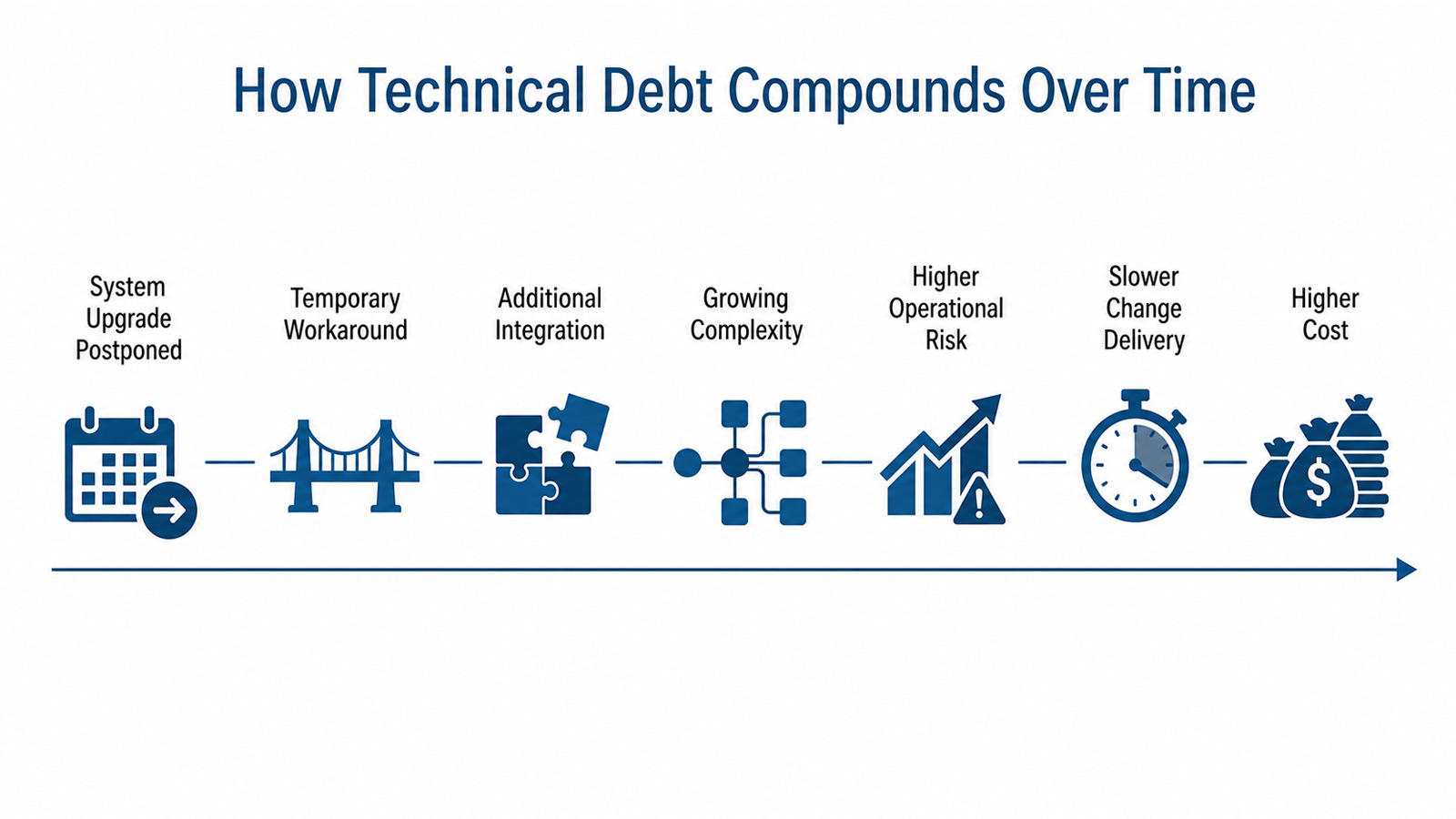
Technical debt is compound interest
The most useful way to understand technical debt is to compare it to compound interest. A single shortcut rarely creates serious problems. Neither does delaying one infrastructure upgrade or extending support for one ageing application. The problem is accumulation. Every temporary solution becomes tomorrow's permanent dependency. Every workaround adds a layer of complexity. Every exception creates an operational process someone must eventually maintain.
The organisation slowly reaches a point where change itself becomes difficult — not because people lack capability, but because complexity absorbs capacity. Engineers spend more time maintaining yesterday's technology than building tomorrow's. Architects design around constraints rather than opportunities. Transformation programmes slow down before they even begin. At that point technical debt stops being an IT problem and becomes an organisational capability problem.
When technical debt becomes a regulatory problem
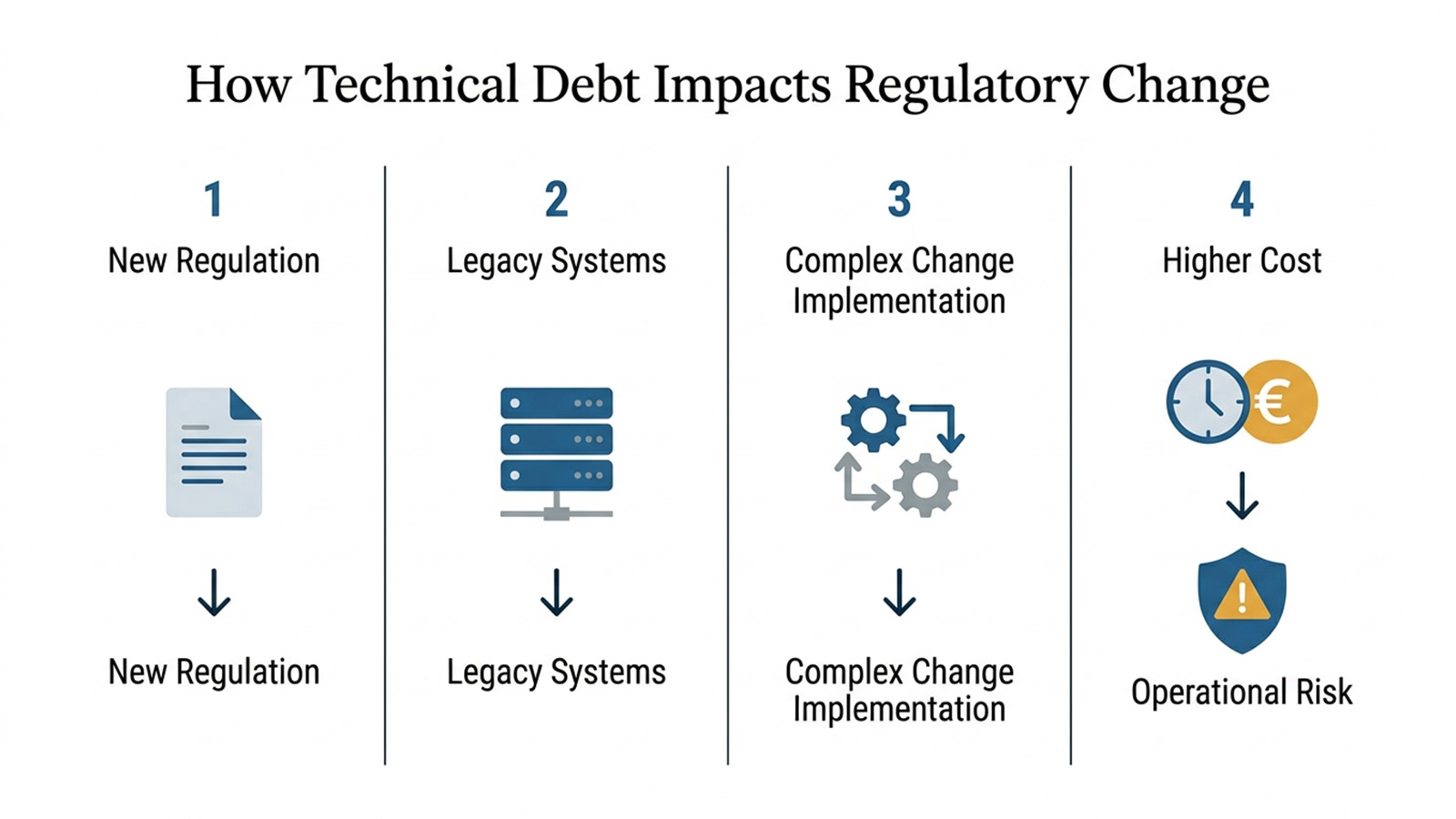
Technical debt is usually discussed in terms of maintenance cost, production incidents and slower delivery. In regulated industries those are rarely the most significant concern. The bigger issue is that technical debt gradually weakens an organisation's ability to demonstrate control. Regulators are not primarily interested in whether an application is modern or old. They care whether an institution can operate safely, consistently and transparently: can critical services stay available, can failures be contained, can risks be identified early, can changes be made without unacceptable operational risk, can management demonstrate effective oversight? Legacy complexity makes each of those questions slower, costlier and riskier to answer.
The pattern is familiar. A new requirement is published, the business understands the objective, compliance interprets the obligations, and technology begins assessment — and that is where complexity surfaces. One regulation may touch dozens of applications, some without active vendor support, some relying on undocumented interfaces, with business logic embedded in systems few people fully understand. A simple regulatory change becomes an enterprise-wide programme, not because the regulation is unusually complex, but because the underlying landscape is. Every cycle therefore becomes more expensive than the last.
Audit findings rarely start in the audit
Many executives experience audit findings as isolated events: internal audit identifies a weakness, external auditors raise observations, supervisors request remediation. The natural response is to treat each finding individually. Yet many share the same underlying cause — technology complexity. When architecture fragments, documentation becomes inconsistent; when documentation is inconsistent, control evidence is harder to produce; when evidence is hard to produce, assurance weakens and findings emerge. The audit merely reveals symptoms that have often existed for years.
Addressing each finding separately may satisfy the immediate requirement, but it rarely addresses the structural cause. Reducing technical debt often eliminates entire categories of recurring findings rather than individual observations. That distinction matters enormously to the cost and credibility of a control environment.
Operational resilience starts long before an incident
Resilience is usually associated with crisis management — incident response, disaster recovery, business continuity. Those capabilities are essential, but resilience begins much earlier: with architectural simplicity. Organisations running hundreds of tightly coupled legacy applications often find that even minor changes have unexpected consequences. Dependencies are unclear, ownership has shifted over time, documentation is outdated, testing is difficult, and recovery is slow because nobody fully understands the whole landscape.
This is why resilience cannot be separated from architecture. The easier systems are to understand, the easier they are to recover; the easier they are to recover, the more resilient the organisation becomes. Modernisation therefore strengthens resilience long before the first incident occurs.
The hidden impact on AI transformation
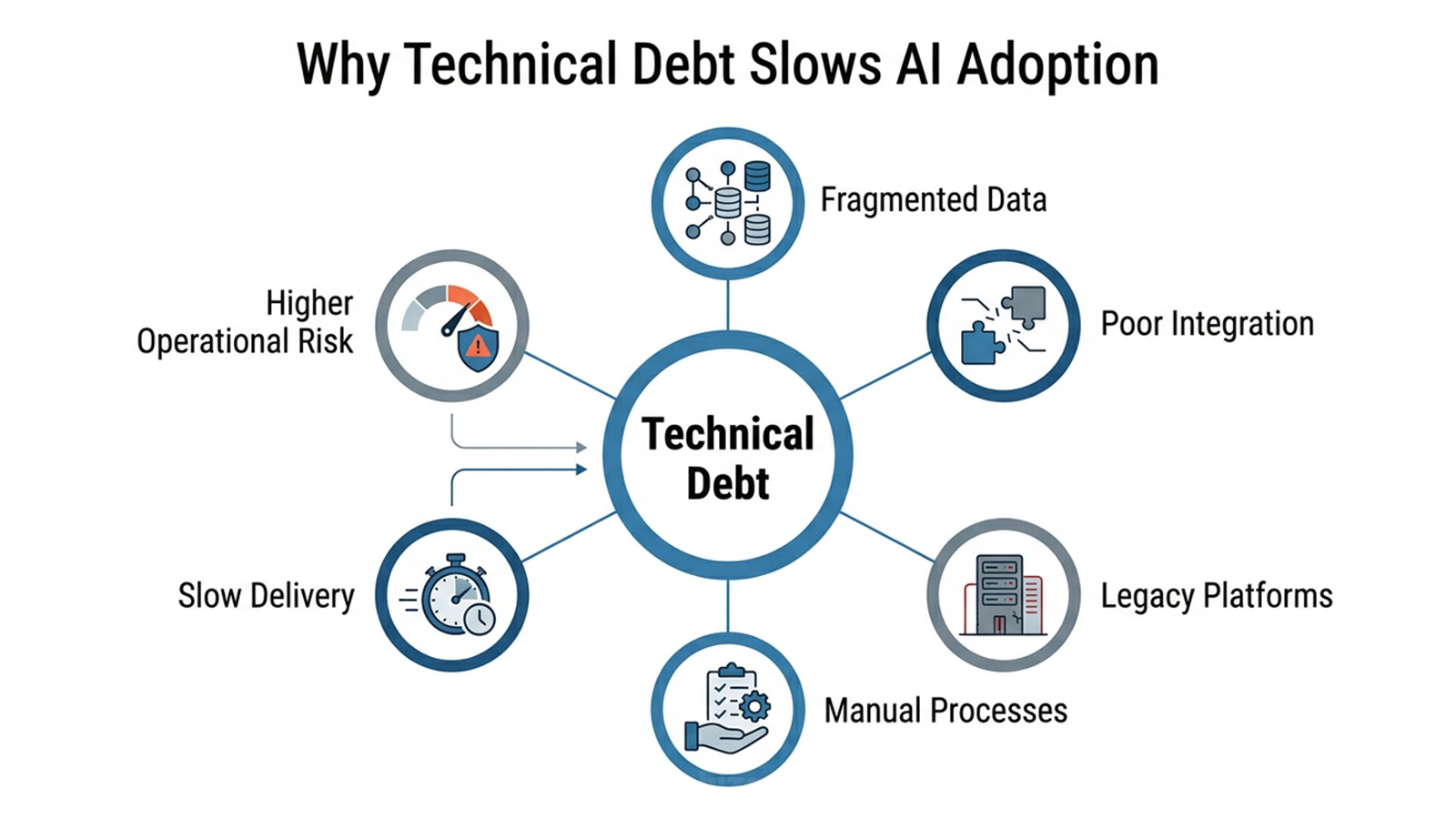
Artificial intelligence has become the strategic priority for many executive teams, yet technical debt quietly shapes AI adoption in ways that are routinely underestimated. AI depends on accessible, trustworthy and well-governed data, and legacy environments rarely provide that foundation. Information is fragmented, interfaces inconsistent, data definitions differ across business units, and integration is expensive. Engineers spend months preparing data before models can even be trained.
Executives sometimes conclude that AI is harder than expected. In reality, AI is exposing weaknesses that already existed. The challenge is not the model; it is the environment into which the model is introduced. This is why organisations with modern platforms consistently scale AI faster than those carrying significant technical debt. The difference is rarely intelligence — it is architectural readiness.
Why boards should care
For many years technical debt was discussed almost exclusively inside technology departments. Those days are over. Boards now oversee technology risk, operational resilience, cyber security, regulatory compliance and increasingly AI — and technical debt directly influences all of them. It affects the ability to adapt, to innovate, to satisfy regulators and to recover from disruption. Most importantly, it affects optionality: every strategic decision becomes constrained by historical technology choices.
Modern organisations compete through speed, adaptability and resilience. Technical debt reduces all three. This is no longer a technology discussion. It is a strategic leadership discussion.
The most expensive decision is often doing nothing
Modernisation requires investment — that is obvious. Less obvious is the cost of postponing it. Delayed decisions rarely eliminate cost; they redistribute it. Lower technology investment today usually results in higher operational expenditure tomorrow, longer transformation programmes, more remediation projects, higher audit costs, more manual controls, growing dependency on specialist knowledge and reduced flexibility. The organisation keeps paying; it simply pays in different ways. Because those costs are spread across multiple budgets, they are difficult to recognise collectively — which is why technical debt remains one of the least visible yet most expensive liabilities inside many large organisations.
| Treated as maintenance | Treated as strategy |
|---|---|
| Replaces systems only when they break | Eliminates complexity before it constrains |
| Measures project delivery | Measures architectural health |
| Absorbs each regulation as a one-off | Designs architecture that absorbs change |
| Spreads cost across many budgets | Makes the true cost visible |
| Slows with every regulatory cycle | Responds faster each cycle |
| Funds maintaining the past | Funds future capability |
Modernisation is not about new technology
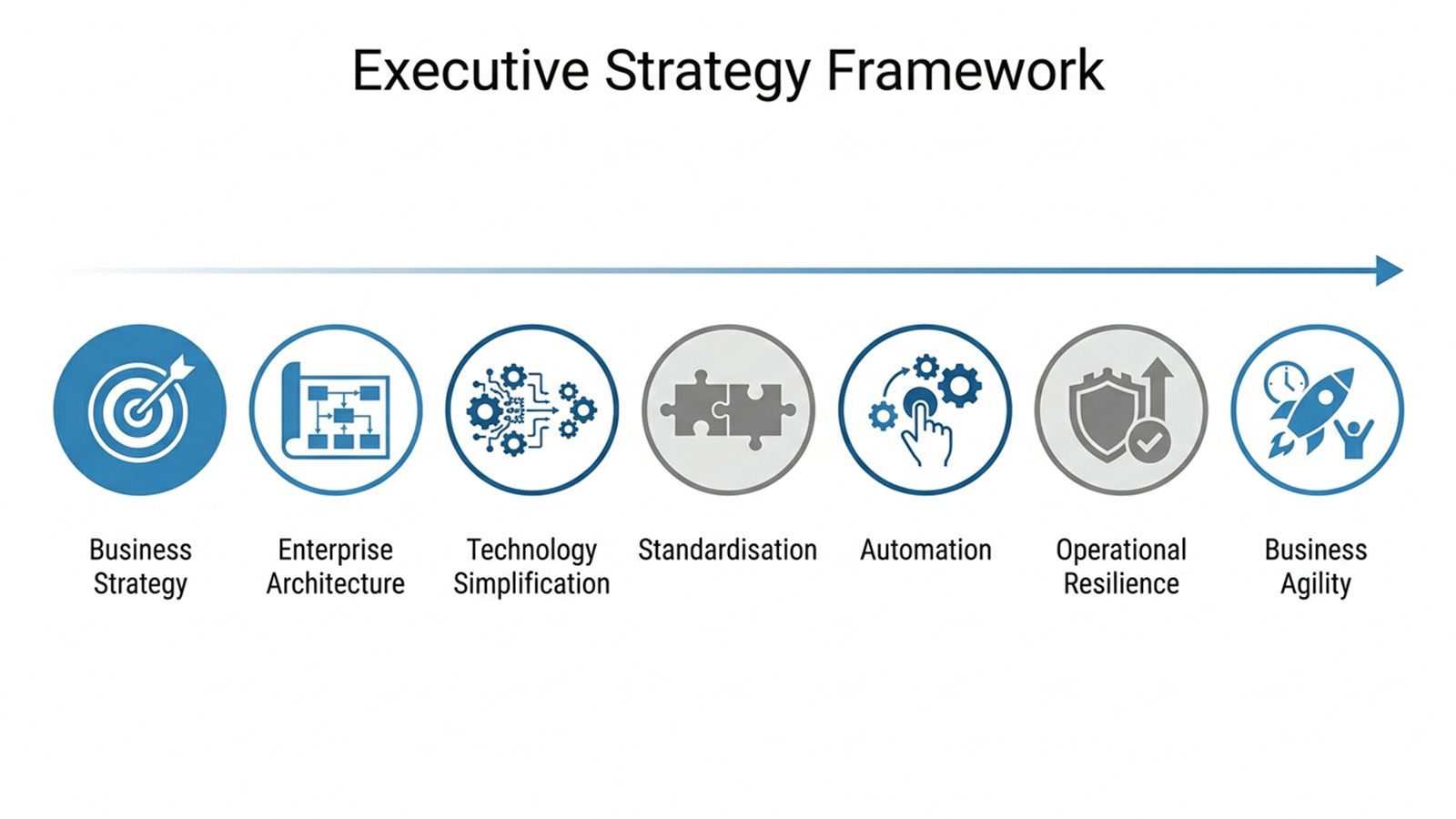
One of the biggest misconceptions is that modernisation is primarily about replacing legacy systems. It isn't. Successful modernisation is about reducing complexity. Many organisations migrate applications to the cloud while preserving exactly the same architectural problems they had on-premises. Others implement modern AI platforms on top of fragmented data, expecting technology to compensate for organisational complexity. It never does. Modernisation should therefore begin with a different question — not “which systems should we replace?” but “which complexity should we eliminate?” That subtle shift changes the entire programme.
1. Reduce complexity before adding capability
Every new capability should reduce overall complexity, not increase it. If introducing AI, cloud or automation requires additional layers of architecture, manual controls or duplicated processes, the organisation may simply be moving complexity rather than removing it. Technology should simplify operations, not complicate them.
2. Build for regulatory change
Regulation will keep evolving — operational resilience, digital operational risk, AI, third-party oversight. Modern landscapes should be designed to absorb change rather than resist it. Architectures built around flexibility respond faster; architectures built around exceptions become more expensive over time.
3. Standardise before you scale
Standardisation almost always precedes scalability: common architecture principles, shared platforms, reusable APIs, standard governance, consistent data models. Without standardisation, every additional project increases complexity. With it, every project strengthens enterprise capability.
4. Measure architectural health
Most organisations measure project delivery; few measure architectural quality. Boards see project status, budget and incidents, but rarely whether the landscape itself is becoming healthier. Useful indicators include reductions in application complexity and unsupported technologies, the number of reusable enterprise services, fewer manual controls, platform consolidation, the time to implement regulatory change, mean time to recover, and the technical-debt backlog trend.
Questions every board should ask
Technology presentations often focus on roadmaps, cloud migrations and upgrades. Those matter, but boards should also ask questions that reveal structural health: are we reducing or increasing architectural complexity, which legacy platforms carry our highest operational risk, how much technical debt has accumulated over three years, which business capabilities are constrained by legacy technology, how quickly can we implement major regulatory change, how much of our estate can be reused across functions, which systems present concentration or resilience risks, and what share of technology investment creates future capability rather than maintaining the past? The answers indicate long-term resilience far better than another successful infrastructure project.
Final thoughts
Technical debt is often described as the price of moving quickly. In regulated environments I believe that definition is incomplete: it is the price of postponing difficult decisions. Every delayed programme, temporary workaround, unsupported integration and undocumented dependency looks manageable alone. Together they reshape the organisation. Over time technology becomes harder to change, resilience weakens, regulatory change slows, transformation grows more expensive, and AI becomes harder to scale. Competitive advantage shifts to organisations that invested in simplification long before they were forced to.
Modernisation should never be viewed solely as an IT initiative. It is an investment in resilience that strengthens governance, improves regulatory responsiveness and enables innovation — and, most importantly, gives organisations the freedom to adapt when the environment inevitably changes again. The institutions that lead the next decade are unlikely to be those with the newest technology. They will be those with the simplest, most resilient and most adaptable foundations. That is what modernisation is really about: not replacing systems, but building organisations that remain capable of changing.
Executive checklist
Before approving another technology investment, ask:
- Are we eliminating complexity or adding to it?
- Does this initiative reduce long-term technical debt?
- Will it improve our ability to respond to future regulation?
- Does it strengthen operational resilience?
- Can it accelerate future AI adoption?
- Does it simplify our technology landscape?
- Are we creating reusable enterprise capabilities?
- Are we investing in tomorrow — or maintaining yesterday?
If several answers are “no,” the organisation is probably funding maintenance rather than transformation.