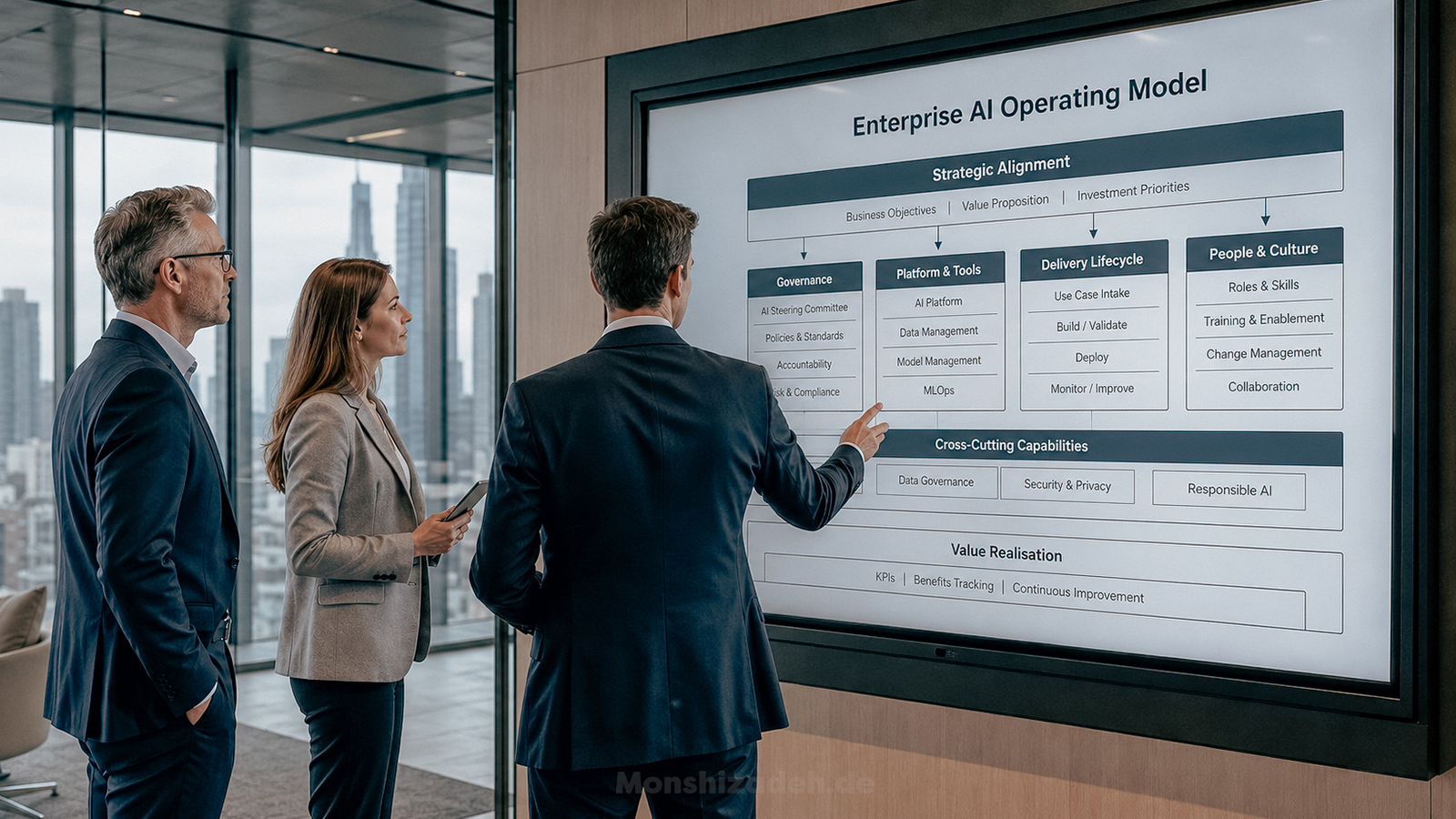
Executive summary
Almost every large organisation today has an AI strategy. Many have invested millions, established AI Centres of Excellence, appointed Chief AI Officers or launched dozens of initiatives. Yet many executives quietly ask the same question: why isn't AI delivering the transformation we expected?
After years leading governance, technology strategy and transformation across international financial institutions, I keep seeing the same pattern. The organisations struggling with AI rarely lack technology. They have excellent engineers, talented data scientists, modern cloud platforms and access to powerful foundation models. Budget is usually not the problem either. Something more fundamental is missing: they never designed how AI should actually operate across the organisation. Everyone focuses on the models. Almost nobody focuses on the operating model. And that is where enterprise AI either succeeds — or quietly falls apart.
A familiar story
Imagine the boardroom of a large organisation. The CEO announces an ambitious AI strategy, the CIO presents a roadmap, the CTO demonstrates new capabilities, and business units showcase dozens of successful pilots. Everything looks promising.
Six months later, Marketing has purchased its own AI platform. Operations is experimenting with another. Compliance has implemented a separate document-intelligence solution. Risk is evaluating three vendors. HR has launched its own chatbot. Finance is building forecasting models on yet another stack. Every department is making progress. Collectively, the organisation is moving nowhere. It happens more often than most executives would like to admit.
AI isn't the problem
One of the biggest misconceptions about enterprise AI is that success depends mainly on choosing the right technology. It doesn't. Technology matters, but it has never been the defining factor behind successful enterprise transformation. ERP implementations, cloud migrations, cyber-security programmes and digital transformation did not fail because software was unavailable. They failed because organisations underestimated governance, ownership, change management and execution.
AI is no different — if anything, it raises the stakes. It introduces entirely new questions. Who owns the models? Who approves them? Who is accountable when they make incorrect decisions? Who determines acceptable risk? How do we measure value? How do we ensure consistency across hundreds of use cases? Without clear answers, AI quickly fragments.
The mistake almost every organisation makes
When a company announces its AI strategy, the conversation usually begins with technology: which large language model, build or buy, which cloud, vector databases, fine-tuning. These are important questions — they just aren't the first questions. The first question is much simpler: how will AI actually operate inside our organisation? That question is surprisingly rare. And yet it changes everything.
Why scaling AI is so difficult
Launching an AI pilot is relatively easy. Scaling AI across a multinational organisation is something entirely different, because scaling has very little to do with models. Scaling means creating repeatable organisational behaviour.
When an AI initiative succeeds, other departments become interested, new funding requests appear, additional use cases emerge and expectations rise. Without a structured operating model, every new initiative starts from scratch — different approval processes, architecture, procurement, security assessments, risk reviews and documentation. Every project reinvents the wheel. That is not innovation. It is organisational inefficiency disguised as innovation.
Organisations scale. Models don't.
This is probably the single most important lesson from large-scale transformation. People say they want to “scale AI.” I disagree. You don't scale AI. You scale organisations. Artificial intelligence is simply another enterprise capability — like cyber security, cloud, enterprise architecture or operational resilience. The technology is rarely the limiting factor. The organisation is. An organisation that makes consistent decisions, applies common standards and learns from previous implementations will scale AI faster than one relying on isolated innovation teams. The operating model determines whether knowledge stays local or becomes organisational capability.
A simple analogy
Imagine asking five departments to implement their own ERP system: Marketing picks Vendor A, Finance prefers Vendor B, Operations builds custom, HR buys SaaS, Compliance develops internally. No executive would approve that — the inefficiencies would be obvious immediately. Yet this is precisely how many organisations approach AI today. Every department experiments independently, negotiates separate contracts, defines its own governance, builds different prompt libraries and follows different review processes. The result is predictable: costs increase, complexity explodes, trust declines, and executives begin questioning the value of AI itself. The irony is that AI isn't failing. The organisation simply never gave it a coherent structure.
The missing layer between strategy and delivery
Most organisations already have two things: strategy, and delivery teams. What they often lack is everything in between. Who decides which initiatives deserve investment? Who owns enterprise priorities? How are competing requests evaluated? Which architectural standards apply? How are risks assessed consistently? How are reusable capabilities shared? How do lessons learned become institutional knowledge rather than staying inside individual teams? These questions define an operating model. Without clear answers, even the best AI strategy remains an ambitious presentation.
The operating model is not bureaucracy
Whenever governance enters the conversation, someone asks: won't this slow us down? Poor governance certainly can — excessive approval layers, ambiguous responsibilities, conflicting committees, documentation for its own sake. But that is not governance. That is bureaucracy. A well-designed operating model does the opposite: it removes uncertainty before projects become expensive. Teams know who decides, architects understand the standards, risk specialists engage early instead of at the end, business owners understand their responsibilities, and technology teams build reusable capabilities instead of isolated solutions. The result is not slower delivery. It is faster delivery with significantly lower execution risk.
The shift every executive needs to make
The organisations that lead the next decade of AI adoption are unlikely to be those with the most sophisticated models. They will be the ones that learn to integrate AI into how they operate every single day. That shift begins with one realisation: AI is not another technology programme. It is an enterprise operating capability. And capabilities do not emerge by accident — they are designed.
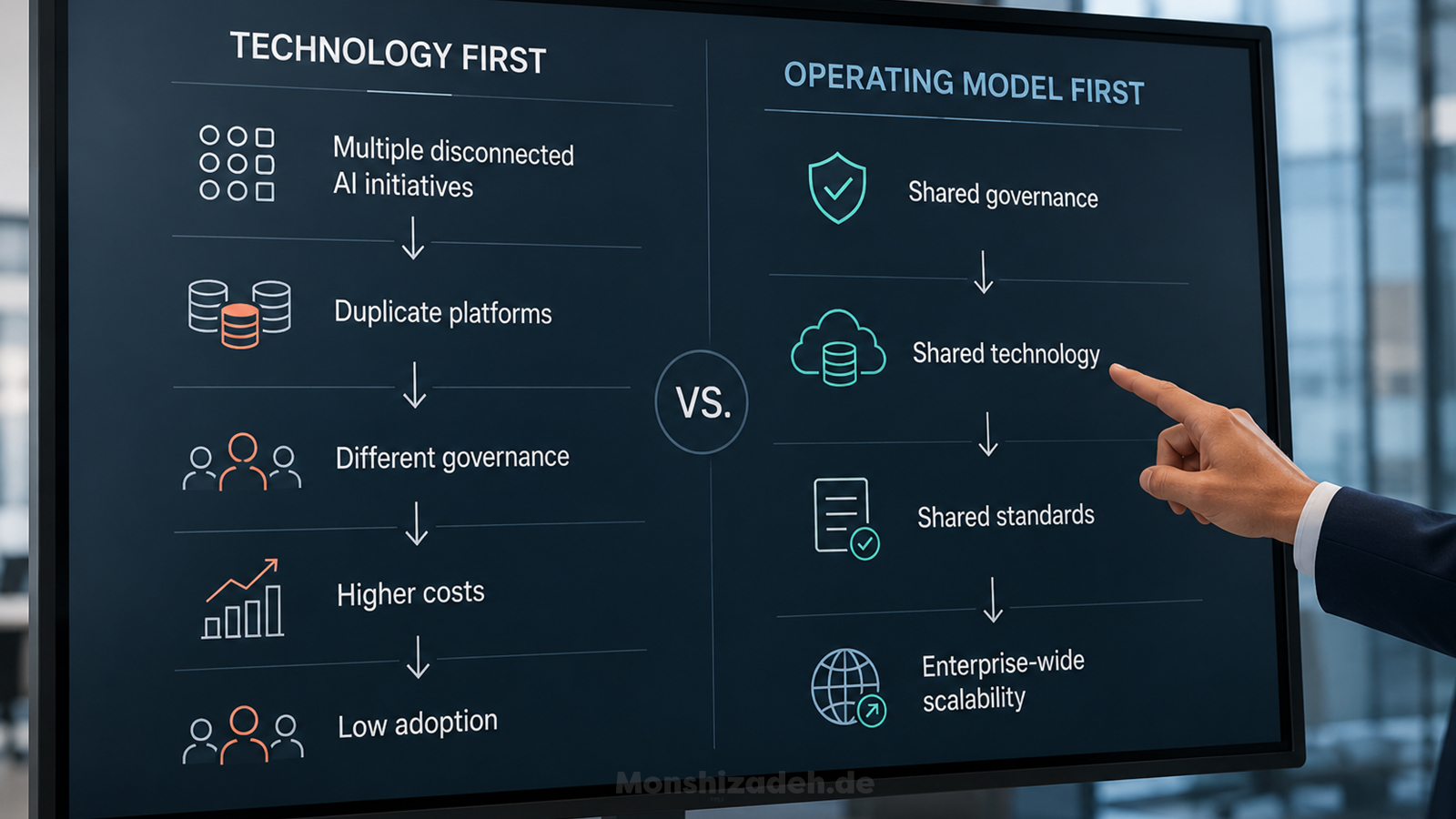
The eight capabilities every enterprise needs
Many organisations ask where they should begin. The answer is almost never “buy better technology.” Instead, start with eight fundamental capabilities that together form the Enterprise AI Operating Model.
1. Strategy
Every AI initiative must answer one question: which business objective does it support? If the answer is unclear, the initiative probably shouldn't exist. Too many organisations build AI because they feel they should; successful ones build AI because it solves a measurable business problem. Good strategy creates focus — without it, AI becomes expensive experimentation.
2. Portfolio management
Not every AI idea deserves investment. Resources, attention and executive sponsorship are limited, so initiatives must compete on transparent criteria: strategic alignment, expected value, data readiness, regulatory impact, technical feasibility, time to value and organisational readiness. The goal is not to approve more projects — it is to approve the right projects.
3. Governance
Governance is one of the most misunderstood concepts in transformation. Many associate it with control; I associate it with clarity. Good governance answers questions before they become problems: who owns the use case, who owns the model, who approves deployment, who accepts operational risk, who measures outcomes. When those answers are clear, projects move faster — not slower.
4. Data
“AI is only as good as its data” has become cliché, yet it remains true. Poor data quality cannot be fixed by a better model; neither can missing ownership, inconsistent definitions or fragmented access rights. Every successful AI capability begins with disciplined data governance. Without trusted data, organisations don't have an AI problem — they have an information problem.
5. Technology platform
Technology should enable standardisation, not fragmentation. A mature enterprise AI platform provides reusable capabilities rather than isolated solutions: foundation models, secure inference environments, prompt libraries, API gateways, a model registry, observability, identity and access management, monitoring, audit logging and security controls. The objective is simple — build once, reuse everywhere.
6. Delivery
Traditional software lifecycles are often insufficient for AI, which adds data exploration, model validation, bias testing, human oversight, continuous retraining and performance monitoring. An effective lifecycle runs from discovery, business case, data assessment, model selection and risk review through pilot, production, monitoring and continuous improvement. Deployment is not the end — it is the beginning of operational responsibility.
7. Risk & compliance
One of the biggest mistakes is involving Risk and Compliance too late — after the model works and stakeholders are excited. Predictably, documentation is incomplete, controls are missing, testing is insufficient and launch is delayed. Not because Risk created problems, but because Risk wasn't included early enough. The best organisations integrate Risk from day one.
8. Value realisation
Deployment is not success. Business value is. An AI solution nobody uses creates no value; a model with outstanding accuracy but no adoption creates no value. Every initiative should define measurable outcomes before development begins: reduced manual effort, faster response times, lower operational risk, higher productivity, improved compliance, revenue growth, cost reduction. Technology metrics are useful; business metrics are essential.
Who owns enterprise AI?
One question appears in almost every executive discussion. Should AI belong to IT? Usually no. Should it belong to the business? Also no. Enterprise AI belongs to the enterprise. Technology builds capability, business owns value, risk defines acceptable boundaries, legal protects compliance, security protects resilience, data enables intelligence and executive leadership provides direction. Ownership is shared; accountability is defined. Confusing those two concepts creates conflict; separating them creates alignment.
The executive AI steering committee
If I could recommend only one governance mechanism, it would be this: create an Executive AI Steering Committee. Not another project board, not another technology committee — a decision-making body. Its purpose is to answer questions such as: which initiatives receive funding, which risks are acceptable, which capabilities become enterprise standards, which vendors align with strategy, where investment should increase, and which initiatives should stop. That last responsibility — stopping projects — is often overlooked. Successful organisations are disciplined enough to discontinue initiatives that no longer create value. That discipline is as important as innovation itself.
Common warning signs
If you recognise several of these symptoms, your organisation may not have an AI problem — it may have an operating-model problem:
- every department uses different AI platforms;
- nobody knows who owns AI governance;
- AI initiatives compete instead of collaborate;
- success is measured by pilots rather than business outcomes;
- risk is engaged at the end of projects;
- architecture differs across business units;
- funding decisions lack transparency;
- models cannot be reused;
- lessons learned remain isolated;
- executive reporting focuses on activity rather than value.
None of these are technology failures. They are operating-model failures.
From framework to execution
Designing an operating model is one thing; making it work across a large organisation is another. This is where many programmes lose momentum. The framework looks impressive, governance documents are approved, committees are established, responsibilities are documented — yet very little changes. Why? Because operating models are often treated as organisational-design exercises instead of behavioural change. An operating model only succeeds when people begin making different decisions because of it. That is the real objective.
The enterprise AI blueprint: five questions
Every successful Enterprise AI Operating Model should answer five fundamental questions.
1. What are we trying to achieve?
Every initiative must support measurable business outcomes — not technology outcomes. Reduce onboarding time by 40%, improve fraud-detection accuracy, reduce manual document processing, increase operational efficiency, improve customer experience, reduce regulatory-reporting effort. Technology is never the objective; business performance is.
2. Who makes decisions?
One of the fastest ways to slow AI is unclear accountability. Define the Executive Sponsor, Business Owner, Product Owner, AI Owner, Data Owner, Risk Owner, Security Owner and Model Owner. Ownership exists at multiple levels — intentionally. Enterprise AI is collaborative by design.
3. Which standards are mandatory?
Establish common standards for architecture, security, model validation, prompt engineering, testing, documentation, monitoring, vendor assessment and responsible AI. Without standards, scaling becomes impossible.
4. Which capabilities should every project reuse?
Successful organisations rarely build everything from scratch. They provide reusable enterprise services: authentication, API gateway, model registry, prompt library, knowledge base, monitoring, risk-assessment templates, governance templates, legal reviews and security controls. Reduce duplication; increase consistency.
5. How do we know whether AI is working?
This sounds simple; it rarely is. Many dashboards measure activity — pilots, users, prompts, models — which tells us little. The better questions are about outcomes.
| Activity metrics (what most dashboards show) | Executive metrics (what to actually ask) |
|---|---|
| Number of pilots | Has productivity improved? |
| Number of users | Has operational risk decreased? |
| Number of prompts | Are customers receiving better service? |
| Number of models | Do employees spend less time on repetitive work? |
| Number of use cases | Is revenue increasing or cost decreasing? |
| Volume of activity reported | Has decision quality improved? |
Those are executive metrics. Activity tells you something is happening; outcomes tell you whether it matters.
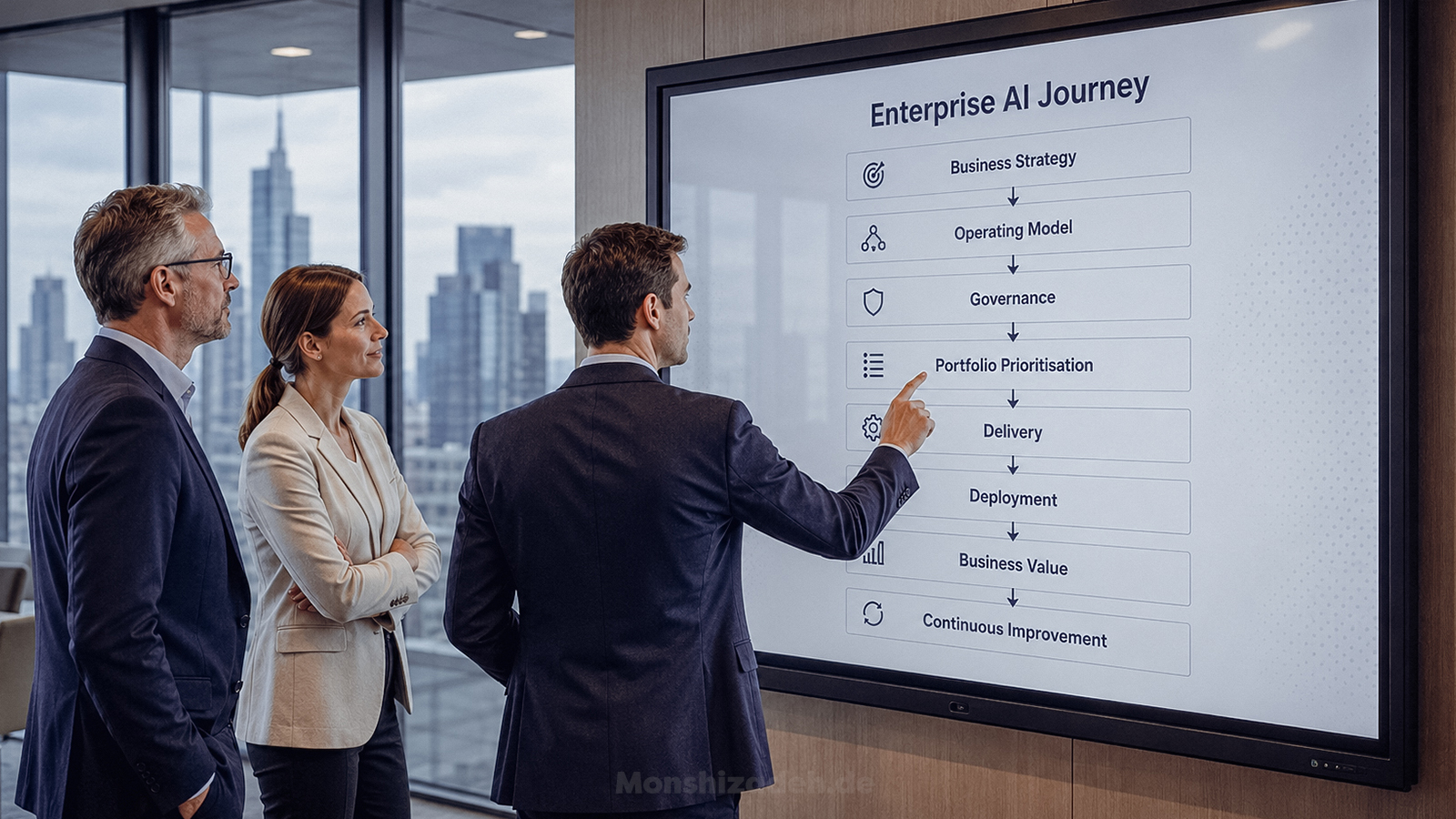
A banking example
Imagine a large European bank. Retail Banking wants an AI assistant, Compliance wants AI-powered document review, Operations wants intelligent workflow automation, Risk wants predictive analytics and Treasury wants forecasting. Traditionally these become five projects — five budgets, vendors, architectures, governance models, security assessments and implementations.
Now imagine the bank establishes a common enterprise AI platform, a single governance framework, one executive steering committee, shared security controls, a shared model lifecycle and shared architecture. Suddenly those five initiatives share capabilities. Costs decrease, delivery accelerates, knowledge becomes reusable, and the organisation starts behaving like one enterprise instead of five independent businesses. That is the purpose of an operating model.
Executive implementation roadmap
Building an Enterprise AI Operating Model should be approached in phases.
Phase 1 — Understand where the organisation is today
Review current AI initiatives, governance, technology landscape, data maturity, executive sponsorship, skills and operating-model maturity. Do not design the future before understanding the present.
Phase 2 — Define the target operating model
Agree decision rights, governance, architecture, delivery lifecycle, platform, risk integration, funding and business ownership.
Phase 3 — Pilot the operating model
Not just AI — the operating model itself. Choose two or three initiatives, apply the framework consistently, then learn, improve and simplify.
Phase 4 — Scale
Only after governance proves effective should the organisation expand. Scaling too early creates technical debt and confusion; scaling too late reduces momentum. Timing matters.
The biggest mistake
After years in governance and transformation, one observation stands out. Companies invest enormous effort selecting AI models, and very few invest the same effort designing the organisation that will use them. That imbalance explains why many AI programmes struggle. Technology receives executive attention; operating models receive executive approval — and those are not the same thing. Real transformation begins only when leadership recognises that AI is no longer an innovation initiative. It has become an enterprise capability, and enterprise capabilities deserve enterprise design.
Final thoughts
I don't believe organisations have an AI problem. I believe most have an operating-model problem. The technology is improving at extraordinary speed; foundation models become more capable every month and infrastructure keeps maturing. The real competitive advantage will not come from access to better AI. It will come from building organisations capable of using AI consistently, responsibly and at scale. The winners will not necessarily own the smartest algorithms. They will own the strongest operating models.
Executive checklist
Before launching another AI initiative, ask:
- Do we have executive sponsorship?
- Is business value clearly defined?
- Are ownership and accountability documented?
- Do we have common governance?
- Is Risk involved from day one?
- Are reusable enterprise capabilities available?
- Are success metrics based on business outcomes?
- Can this initiative scale across the organisation?
If several answers are “no,” the next investment should probably not be another AI model. It should be your Enterprise AI Operating Model.